My Cart (0 )
Is there a “green tea tree,” an “oolong tree,” or a “black tea tree”?
- Tea Reviews - Black / Red Teas
- June 29, 2025

Actually, all true teas—whether green, oolong, black, white, yellow, or dark tea—come from one and the same species: Camellia sinensis.
Most of the world’s oldest tea trees are found in South-western China, and from here, Camellia sinensis spread out towards Eastern China, Myanmar and Vietnam in the south and North-eastern India in the west. Adapting to a wide variety of climates, soils, altitudes, and water conditions, the plant diversified in leaf size, shape, and the aromatic compounds it produces. This natural variation, combined with human-led cultivation and hybridization, has given rise to the vast array of tea cultivars and flavour profiles we enjoy today.
Differences between variety and cultivar
| Feature | Variety | Cultivar |
| Origin | Naturally occurring | Human-developed |
| Propagation | Seed propagation | Vegetative methods (cuttings, grafting) |
| Naming | Lowercase, italicized, preceded by “var.” Eg. Wild puerh tea trees are name Camellia sinensis var. assamica | Capitalized, single quotes, not italic Eg.Jinxuan is Camellia sinensis TRES #12 |
| Legal Status | Not protected | Often protected by patents |
Technically, any tea variety or cultivar can be crafted into green, oolong, black, white, yellow or dark tea, simply by adjusting the oxidation level and any subsequent fermentation.
However, in practice, most cultivars are traditionally used to produce one—and occasionally two—tea types, typically green and black. This preference reflects the cultivar’s inherent characteristics, the traditional expertise of the region, and the reputation of the tea itself.
For example, Longjing, the renowned green tea from Zhejiang, is rarely used for anything other than its signature green form. A Longjing black tea, for instance, would struggle to match the flavour or prestige of other black teas—like Darjeeling—and would be priced accordingly. As a result, few growers venture beyond the traditional path. The fame, flavour profile, and commercial value of a tea often hinge on maintaining its established identity.
1 cultivar, 3 different teas
金萱 (Jīn Xuān ) or 台12 (Tái 12), has traditionally been processed into oolong tea. However, our longtime partner in 阿里山 (Ālǐshān) has developed a unique technique that transforms this hybrid cultivar into three distinct tea styles: green tea, oolong, and black tea .
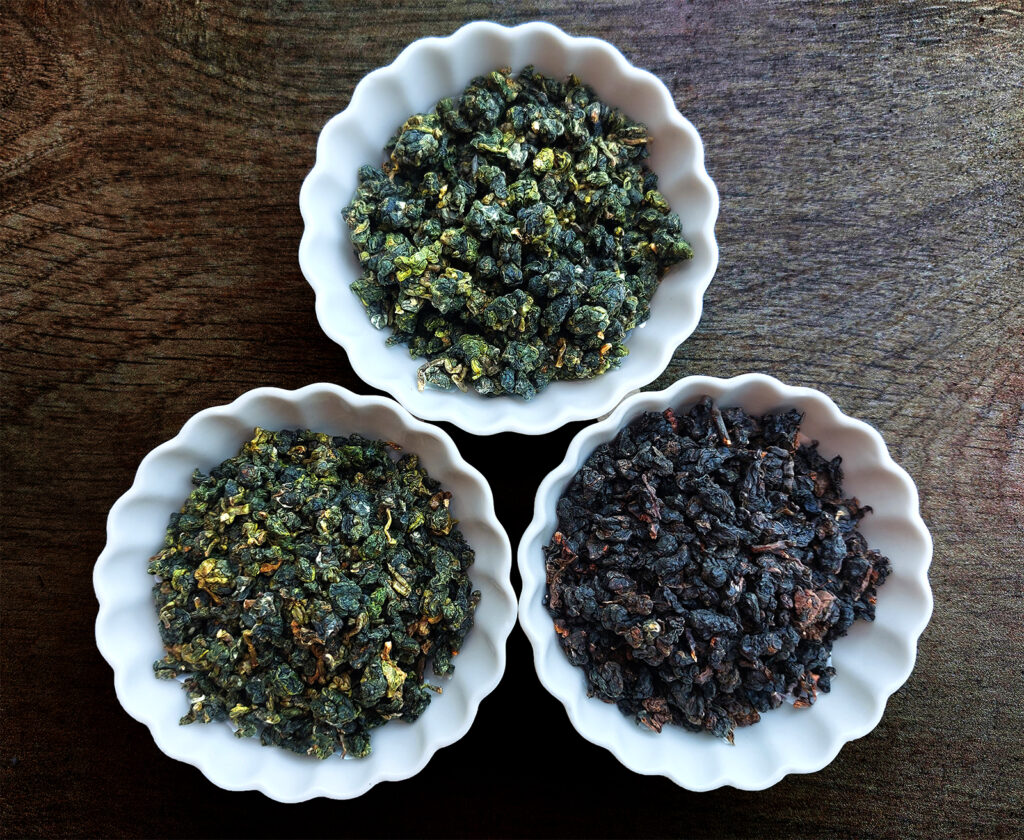
from the top clockwise: dry leaves of Jinxuan green tea, black tea, oolong
Color: Green tea remains bright and light green because it is unoxidized. Oolong tea, being partially oxidized, darkens to medium or deep green. Black tea, which undergoes full oxidation, transforms into dark brown to reddish-black leaves.
Shape: Notice how both the green tea and black tea are rolled into balls, a shape typically seen in oolong teas. Green teas are more commonly rolled into long flat strips like 龙井(Lóngjǐng) or needle-like shapes as seen with Japanese Sencha (also known as 煎茶 (jiān chá) in China). Black teas almost always appear as loose strips.
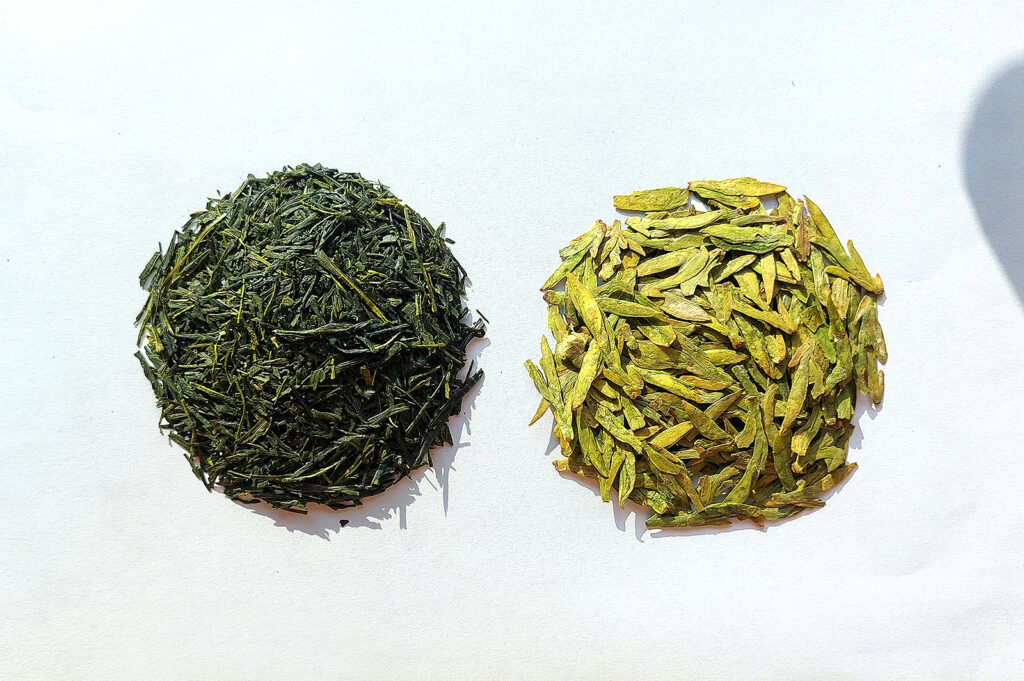
Although oolongs are often thought of as being shaped like small balls, that’s not always the case. There are many Chinese oolongs—especially 武夷岩茶 (Wǔyí yánchá) from Northern Fujian and 凤凰单丛 (Fènghuáng Dān Cōng) from Guangdong — that come in strip-shaped forms. These long, twisted leaves are usually dark or nearly black, and at first glance, they can easily be mistaken for black tea.
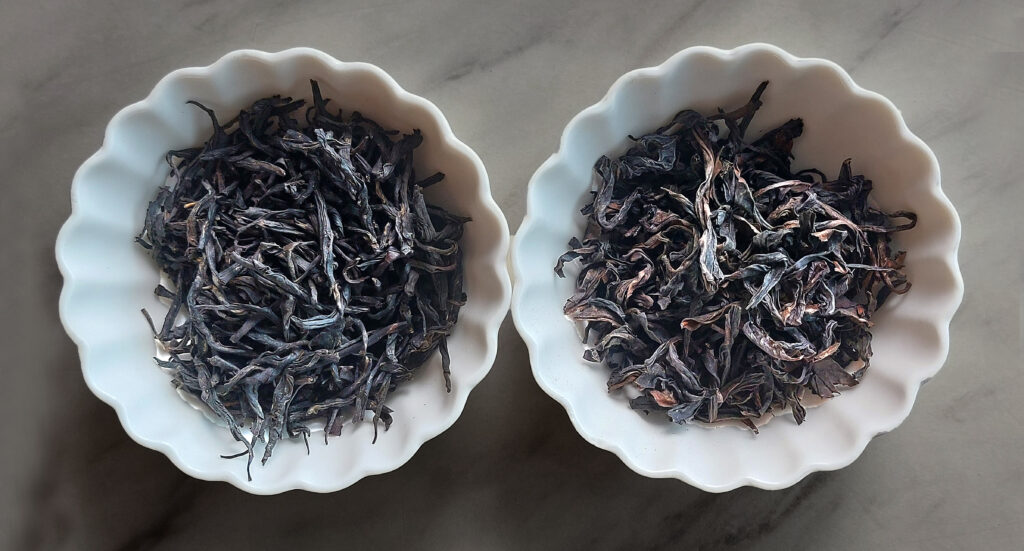
Both teas originate from Fujian province. Can you tell which is a black tea and which is oolong? Left: 正山小种 (Zhèngshān Xiǎozhǒng) black tea. Right: 武夷岩茶 (Wǔyí yánchá) oolong tea
In addition, because oolong tea undergoes partial oxidization, lightly oxidized oolongs, around 10–30% oxidation, exhibit characteristics similar to green tea, while heavily oxidized oolongs, ranging from 80-90% oxidation approach the colour and flavour profile of black tea,.
Characteristics of green, oolong, black tea are summarized below:
| Oxidation Level | Tea Type (Example) | Dry Leaf Color | Tea Liquor Color | |
| Green Tea | 0% | Longjing | Green | Pale Yellow/Green |
| Oolong | 10–20% | Light Oolong (e.g. Jinxuan oolong) | Bright green to jade | Pale yellow |
| 30–50% | Traditional Anxi Tieguanyin | Dark green with brown hints | Golden yellow | |
| 60–90% | Wuyi Rougui | Dark brown to reddish black | Orange to deep amber | |
| Black Tea | 100% | Darjeeling | Dark, reddish-black | Dark Red/Amber |

from top left clockwise: liquors of Jinxuan green tea, oolong, black tea
As you can see, it is difficult to classify teas according to their appearance.
The critical factor that categorises green, oolong and black teas is their level of oxidation.
What is oxidation and its significance in producing green tea, oolong and black teas?
Fresh tea leaves are typically harvested in spring, a season when new buds and tender leaves contain the highest concentrations of flavour compounds, having been stored during the tree’s dormancy over the preceding winter. While green and black teas predominantly utilize young buds and tender leaves, Alishan oolongs are uniquely crafted from tender, mature leaves. Alishan Jinxuan oolong is expertly hand-picked using the “one bud plus three leaves” standard, a hallmark of premium oolong quality.
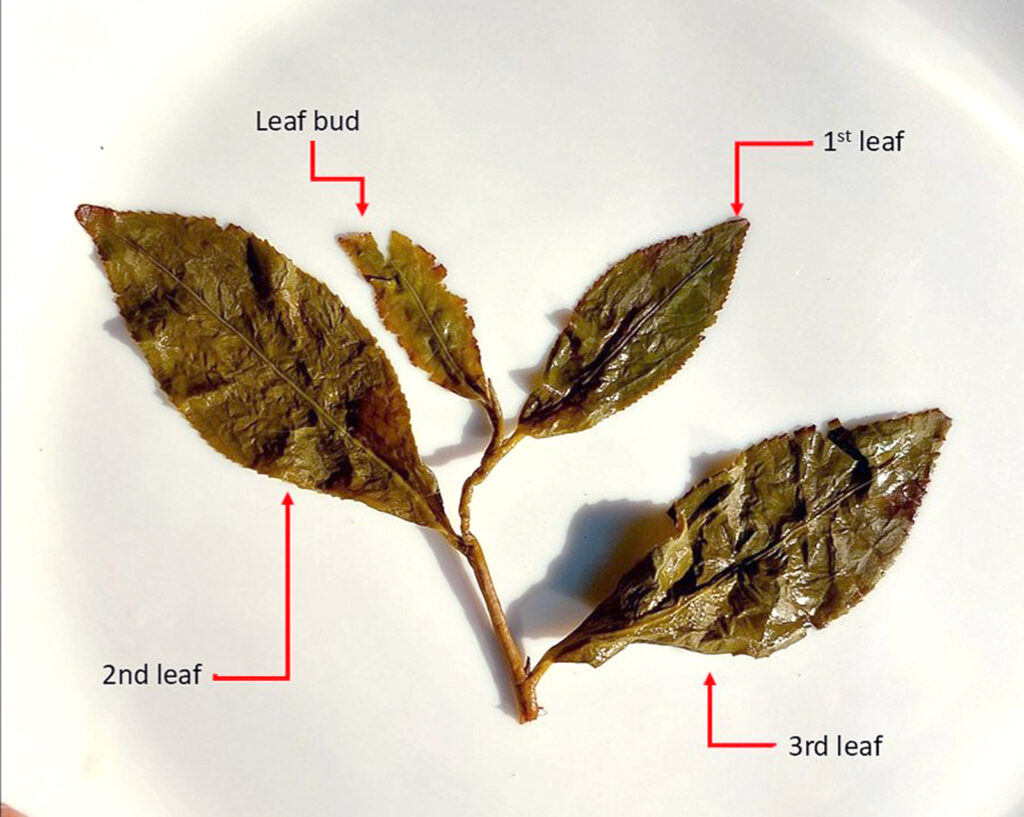
1 bud plus 3 leaves
Taiwan high mountain oolong teas are best crafted using the “1 bud plus 3 leaves” picking standard. Topmost bud delivers vivid, fresh, floral notes, while the slightly mature 2nd and 3rd leaves bring depth, complexity, and body.
After fresh tea leaves are hand-picked, they are thinly spread on mats under the sun to begin the first step of oolong production: 萎凋 (wěi diāo) or withering.
leaves withering under the sun
萎凋 (wěi diāo) or withering: Harnessing the warmth of the sun, leaves begin to lose their moisture, causing their cell walls to weaken and breakdown.
tossing of leaves
浪青 ( làng qìng) or tossing of leaves: After the leaves reach the ideal stage of withering, they are carefully transferred onto large, flat bamboo trays for the next transformative step: tossing, Tossing movements causes leaves to gently rub against each other, breaking down more cell walls and increasing oxygen exposure, while drawing moisture from deep within the leaf to the surface, promoting further water loss. This stage of accelerated oxidation is the defining stage in making of oolong tea and is visible in the red-coloured edges of leaves, and when floral fragrances get intensified.
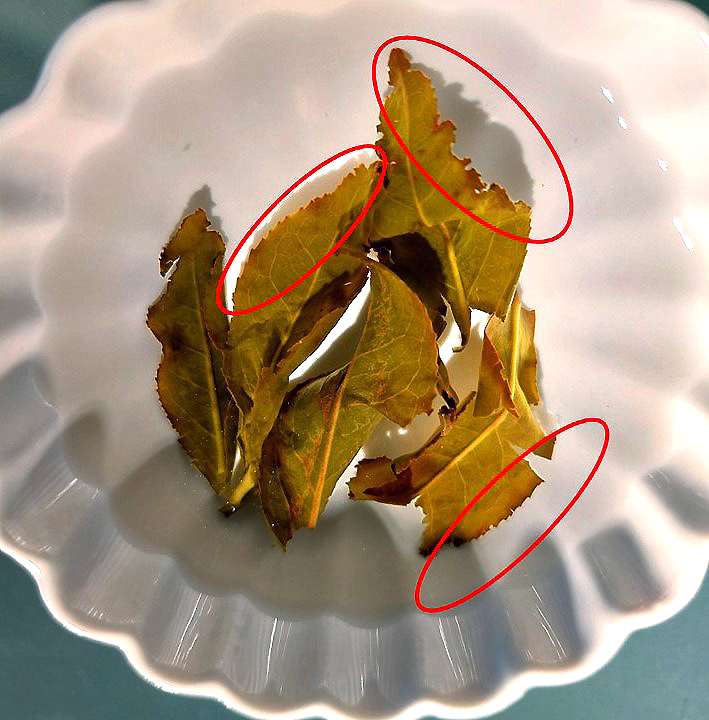
oolong leaves with red edges
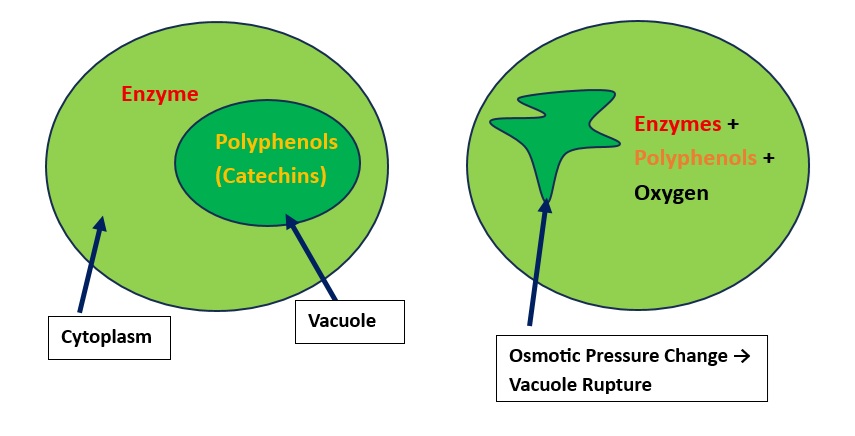
Polyphenols like catechins are stored within the vacuoles of tea leaf cells. During withering, and especially tossing or rolling, the leaves are damaged—moisture loss creates osmotic pressure that ruptures the vacuole, releasing catechins into the cytoplasm. Once exposed to enzymes in the cytoplasm and oxygen, these catechins undergo enzymatic oxidation, transforming into flavourful compounds.
deactivating enzymes
杀青 (shā qīng) or deactivate enzymes: When the tea reaches the desired level of oxidation, the process is halted by applying high heat, a step known as 杀青 (shā qīng). This denatures the enzymes and stops the reaction between enzymes and catechins. This careful heating not only locks in the tea’s floral fragrance and flavour profile, but also ensures that oxidation doesn’t continue uncontrolled, which could otherwise alter the tea’s character.
rolling leaves
揉捻(róu niǎn) or rolling of leaves: By applying pressure and rolling movements, cell structures are heavily broken down and flavourful products formed during oxidation in the cytoplasm are released onto the leaf surface, which readily dissolve in water when the tea leaves are brewed.
drying leaves
Drying is the final key stage in tea processing. Leaves are heated – typically using ovens or fluidized bed dryers – until moisture content falls below 5%. This ensures the tea is shelf-stable, preventing spoilage or mould development during storage.
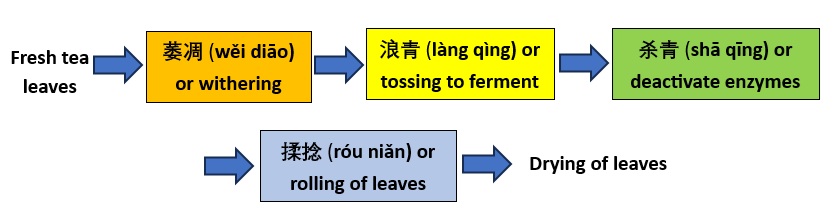
The making of oolong tea involves the greatest number of steps. Green and black tea making requires a smaller number of steps:
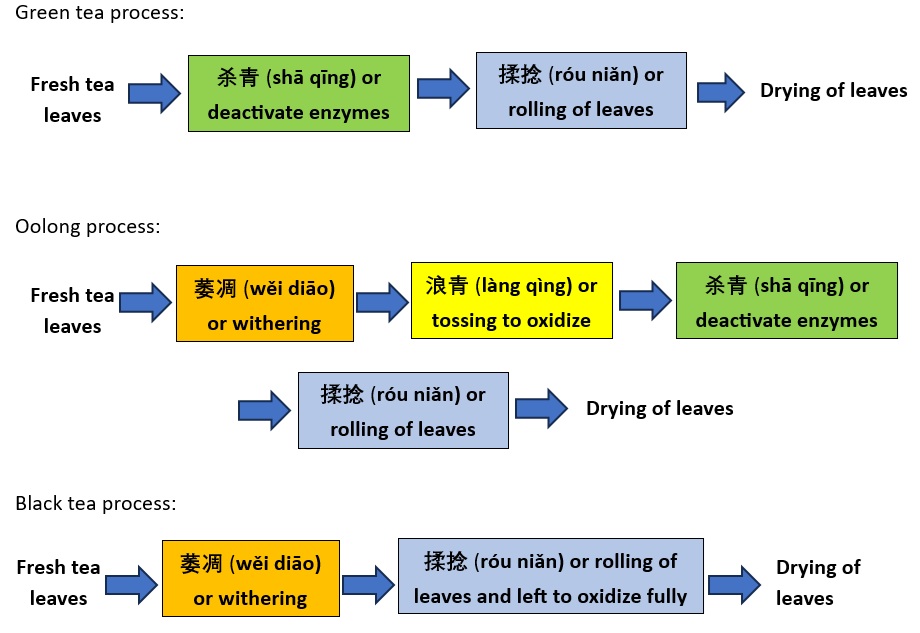
Regardless of the number of steps, each tea type has its own character and appeal.
Brewing Methods
Each tea sample was prepared using three distinct brewing variations:
| Variation | Description |
| 1. Hot Brew | 2g tea in 100ml boiling water. 1st brew: 6 minutes; 2nd brew: 10 minutes. |
| 2. Milk Tea | 4g tea in 100ml boiling water, steeped for 20 minutes. Strain leaves, then add 1 tsp brown sugar and 1 tbsp milk. |
| 3. Cold Brew | 3g tea in 100ml room-temperature water, refrigerated for 48 hours. |
Jin Xuan green tea – Tasting Notes & Brewing RecommendationsFlavour Profile:
Sweet fragrance of sugar cane, sweet corns and water chestnuts with floral undertones. Light, bright and refreshing body.
Hot Brew
- Thanks to its distinctive cultivar, you can brew more than 2 g of leaves to enjoy the full intensity of sugar cane, butter and vanilla. Like many green teas, it carries a gentle astringency – making it a delightful companion to sweet and buttery desserts, such as cakes and sweets.
- Because Jin Xuan green tea retains high levels of unoxidized polyphenols, brewing it unleashes a distinctive sensation—a bright, uplifting tingle at the back of the tongue. These natural compounds enrich the tea’s structure, offering a clean, vibrant finish that complements its creamy sweetness.
- To fully appreciate the visual beauty of this tea, brew it in a glass or ceramic gaiwan and watch the broad and succulent green leaves slowly unfurl
Milk Tea
- Green teas are not as bold as black teas or some oolongs tea, adding milk overpowers tea flavours.
Cold Brew
To maintain flavor and freshness, cold brew tea leaves should stay in the fridge for no more than 48 hours. After that, quality and freshness decline significantly.
Delightfully refreshing, especially when enjoyed cold—this oolong reveals tropical fruit notes like lychee and rambutan that are much more pronounced in cold brews. These bright, juicy flavors often remain subtle or hidden in hot brews.
Boost the flavor with a larger leaf dose (over 3 g) for a more robust brew and add ½ tsp of brown sugar and a drop of milk to create a wonderfully fruity-sweet with a subtle, wholesome bitter edge. Milk can enhance creaminess, but less is more—adding too much milk will drown out the tea’s flavour.
Recommendation:
🌿 Best Brewing Methods: Hot or cold brewed.
Jin Xuan oolong – Tasting Notes & Brewing Recommendations
Flavor Profile
An deeper, more indulgent Jin Xuan green tea, with the buttery aroma of slow-reduced caramelized sugar cane and thick corn syrup.
Hot Brew
- A rounder & sweeter take on Jinxuan green tea, fruity like ripe apricots, smooth and not astringent, thanks to a light oxidation that softens some polyphenols
- Mellow buttery mouthfeel with a light, syrupy sweetness reminiscent of melon.
- The body feels more grounded and substantial, without the uplifted brightness typical of lighter Jinxuan green tea
Milk Tea
- Adding milk masks the tea’s natural flavors and flattens its profile
Cold Brew
- The tea’s body is luxuriously syrupy—imagine reducing lychee and rambutan juices into a sweet, viscous nectar, with a delicate bitter note to balance the lush fruitiness.
- Add 1/2 tsp sugar and a small splash of milk – milk proteins bind tannins, softening bitterness, enabling more delicate floral aromas to emerge
- To maintain flavor and freshness, cold brew tea leaves should stay in the fridge for no more than 48 hours. After that, quality and freshness decline significantly.
Recommendation:
🌿 Best Brewing Methods: Hot or cold brewed.
Jin Xuan black tea (High Mountain black tea)
For Tasting Notes & Brewing Recommendations please refer to:
Being fully oxidized, polyphenols in fresh tea leaves are transformed into:
- Theaflavins (responsible for the bright reddish-orange color of black tea liquor and briskness and astringency of the tea) and
- Thearubigins (contributes to the dark brown color and body of the tea liquor).
What to look out for when brewing black tea:
1. Water Temperature
| Temperature | Effects on Compounds | Tea Liquor Appearance | Notes |
| 90–100°C | Maximizes extraction of theaflavins & thearubigins | Rich red-brown colour | May increase bitterness if over brewed |
| <80° | Lower polyphenol extraction | Pale | Milder taste |
2. Steeping Time
| Time | Compound Ratio | Tea Liquor Appearance | Notes |
| 1–2 minutes | Higher theaflavin than thearubigin | Bright reddish-orange | Light body, brisk |
| 3–5+ minutes | More thearubigins | Darker brown-red | Stronger, fuller-bodied tea |
Final thoughts
Jinxuan green tea and lightly oxidized oolongs like Jinxuan oolong are better enjoyed neat, and pairs well with light desserts like pandan cakes, mochi and mango sticky rice. Black teas, being bolder, pairs well with egg tarts, 豆沙饼(dòu shā bǐng) – my favourite, butter biscuits, mooncakes.
Just like the Tibetans who like 酥油茶 (sū yóu chá), we can have our version here: Chew a small piece of cow’s cheese like Gouda, Parmigiano-Reggiano (Parmesan) or sheep’s cheese (Manchego) and sip a mouth of Jinxuan black tea. Powerful and intense, with a burst of flavors.